
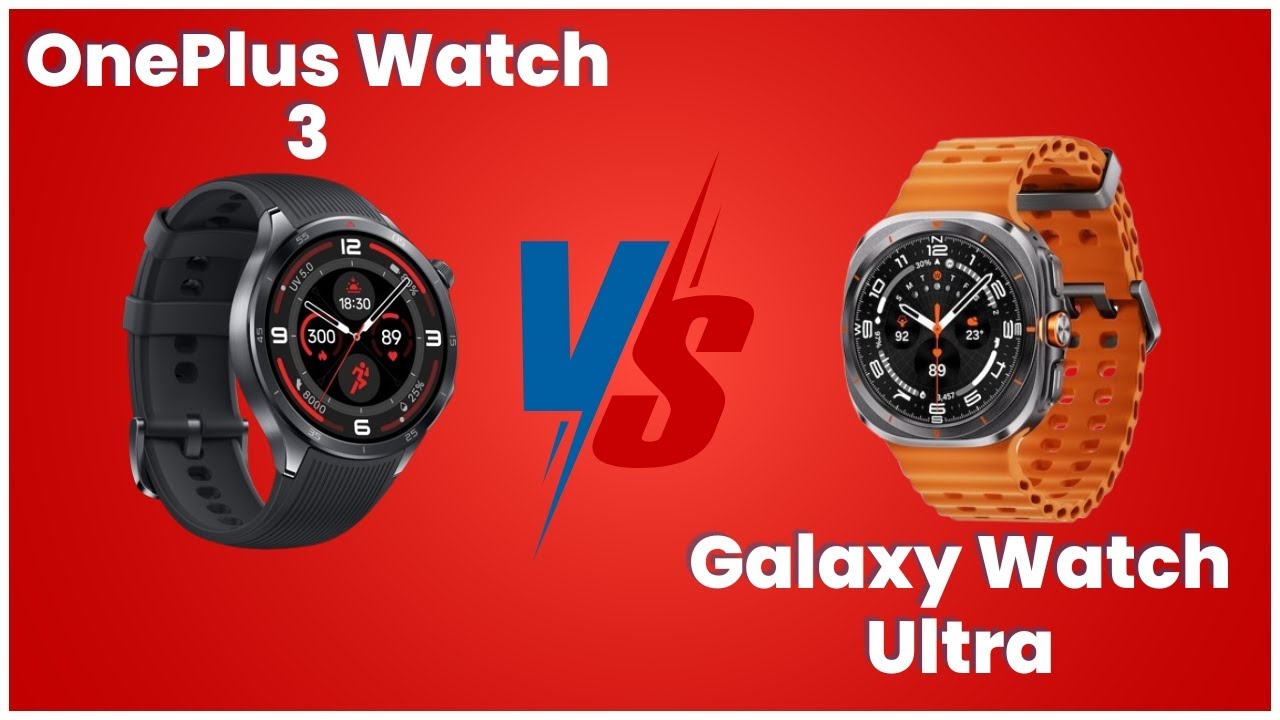
Smartwatch Showdown: Galaxy Watch Ultra vs OnePlus Watch 3 – Which One Really Delivers?
The smartwatch market in 2025 has reached a new level of innovation. Two premium models are at the center of attention: the Samsung Galaxy Watch Ultra and the OnePlus Watch 3 (46mm). Both deliver flagship hardware, impressive software integration, and advanced health tracking features. Yet, they cater to slightly different audiences.
Samsung focuses on rugged durability and ecosystem connectivity, while OnePlus emphasizes long-lasting performance, efficiency, and elegant design. This comparison explores how both watches perform in real-world use, helping you decide which one truly deserves your wrist.
Key Specifications Comparison
| Feature | Samsung Galaxy Watch Ultra | OnePlus Watch 3 (46mm) |
|---|---|---|
| Build Material | Titanium (Grade 4 and Grade 2 composite) | Stainless Steel with Titanium Bezel |
| Display | 1.5-inch Super AMOLED, 480×480, Sapphire Crystal | 1.5-inch AMOLED, 466×466, Sapphire Glass |
| Brightness | Up to 3000 nits | Up to 1000 nits |
| Processor | Exynos W1000 (3nm) | Snapdragon W5 + BES 2700 Dual Chip |
| RAM / Storage | 2GB / 32GB | 2GB / 32GB |
| Operating System | Wear OS 5 with One UI Watch | Wear OS 5 with OHealth Interface |
| Water Resistance | 10ATM / IP68 / MIL-STD-810H | 5ATM / IP68 |
| Health Sensors | Heart Rate, SpO2, ECG, Body Composition, Skin Temperature | Heart Rate, SpO2, ECG (region-limited), Arterial Stiffness, Sleep, Stress |
| Battery | 590mAh | 631mAh |
| Battery Life | Up to 2 days (Always-On Display On) | Up to 5 days (AOD On) / 10–14 days (Power Saver) |
| Charging Speed | 0–100% in about 90 mins | 0–100% in about 60 mins |
| Connectivity | Bluetooth 5.3, Wi-Fi, Dual-frequency GPS, LTE (optional) | Bluetooth 5.3, Wi-Fi, Dual-frequency GPS |
| Special Features | AI Energy Score, Loud Siren, Double Pinch Gesture | Dual Chip Efficiency, VOOC Fast Charging, Dynamic Wellness AI |
| Compatibility | Android (best with Samsung phones) | Android (best with OnePlus devices) |
Design and Build Quality
Samsung’s Galaxy Watch Ultra is built like a tank yet designed with finesse. The titanium frame provides durability without adding excess weight. Its raised bezel and slightly square design with a circular display set it apart visually. This design supports 100 meters of water resistance and passes military-grade endurance tests. The orange action button stands out both visually and functionally, giving quick access to workouts or emergency modes.
The OnePlus Watch 3 offers a sleeker, more traditional round profile. The stainless-steel body with a titanium bezel strikes a balance between sophistication and strength. The rotating crown feels premium and practical, enhancing menu navigation. It lacks the extreme ruggedness of Samsung’s titanium shell but wins in everyday comfort and wrist appeal.
In short, Samsung wins for outdoor durability, while OnePlus delivers elegance suitable for professional and casual wear.
Display and Interface
Both watches feature 1.5-inch AMOLED panels protected by sapphire glass. Samsung’s screen reaches up to 3000 nits, making it ideal for bright outdoor use. The Super AMOLED display is vibrant, crisp, and highly visible under any lighting condition.
OnePlus counters with a vivid AMOLED panel that maintains excellent clarity and contrast, even though it peaks at 1000 nits. The difference in brightness is noticeable outdoors, but OnePlus improves the overall navigation experience with its rotating crown, which feels intuitive and tactile compared to Samsung’s digital interaction.
Samsung wins in display performance and outdoor visibility, while OnePlus offers a smoother user interface through mechanical control.
Performance and Software
Performance is where the OnePlus Watch 3 introduces innovation. The Snapdragon W5 chip works alongside a secondary BES 2700 chip that handles low-power tasks. This dual-chip setup dynamically switches between high and low power modes, resulting in seamless operation and impressive energy efficiency.
Samsung’s Exynos W1000, built on a 3nm process, ensures strong app responsiveness and smooth Wear OS navigation. However, due to the Galaxy Watch Ultra’s higher display brightness and advanced sensors, its power demand is greater, slightly reducing battery efficiency.
Both watches run on Wear OS 5. Samsung’s One UI Watch overlay provides deep ecosystem integration with Galaxy devices, offering enhanced features like SmartThings, Bixby, and Samsung Pay. OnePlus’s OHealth interface keeps things simple, prioritizing speed, clean visuals, and easy accessibility.
Power users who want richer integrations may lean toward Samsung, while those who prefer lightweight, efficient navigation will enjoy the OnePlus interface more.
Health and Fitness Tracking
Health tracking has become the defining category for smartwatches, and both brands deliver exceptional results.
The Galaxy Watch Ultra features Samsung’s advanced BioActive sensor array, which measures heart rate, SpO2, skin temperature, body composition, and ECG. It also introduces the AI-based Energy Score system that calculates readiness by analyzing sleep, stress, and activity levels. Its body composition analysis remains a standout, offering deeper health insights like skeletal muscle and body water data.
The OnePlus Watch 3 includes a comprehensive sensor package with heart rate, SpO2, and arterial stiffness measurement. It features a quick 60-second health scan that compiles multiple metrics, providing an overview of your daily wellness. It can also track naps, a feature Samsung lacks.
Samsung’s Health app offers more depth and social features such as challenges and guided workouts, while the OnePlus OHealth app is more minimalist but continues to evolve with real-time AI wellness scoring.
Both watches are accurate enough for daily fitness tracking, but Samsung edges ahead in sensor variety, while OnePlus excels in overall efficiency and accessibility.
Battery and Charging
Battery life is where the OnePlus Watch 3 truly dominates. Its 631mAh battery, optimized through the dual-chip architecture, delivers up to 5 days of full use and up to 14 days in Power Saver mode. It continues to run most health features even in low-power operation. A 10-minute VOOC charge can provide an entire day of power, making it the most convenient option for heavy users.
Samsung’s Galaxy Watch Ultra, despite having a large 590mAh cell, averages about 2 days of battery life with Always-On Display enabled. While acceptable for its performance class, it cannot match the efficiency of the OnePlus design. Charging time is about 90 minutes, compared to OnePlus’s faster 60-minute full charge.
In practical terms, the OnePlus Watch 3 offers the freedom to travel without constantly worrying about recharging, while Samsung delivers consistent endurance for active, sensor-heavy usage.
Connectivity and Ecosystem
Samsung’s strength lies in its cohesive ecosystem. The Galaxy Watch Ultra connects seamlessly with Galaxy smartphones, offering features like Samsung Pay, SmartThings automation, and optional LTE independence. It is the best smartwatch for users already within the Samsung environment.
The OnePlus Watch 3 supports a wide range of Android devices with stable Bluetooth 5.3 and dual-frequency GPS. While it integrates best with OnePlus phones, it maintains full Wear OS app compatibility. It lacks LTE options but remains reliable for calls, notifications, and workouts.
Those deeply embedded in Samsung’s ecosystem will benefit from the Watch Ultra’s tight integration, while Android users who want flexibility without brand lock-in will prefer OnePlus.
Verdict
Both watches deliver flagship experiences but cater to different user priorities.
The Galaxy Watch Ultra stands out for durability, advanced health tracking, and brightness performance. It is ideal for outdoor enthusiasts and Samsung users who need deep ecosystem connectivity.
The OnePlus Watch 3 (46mm) focuses on efficiency, comfort, and intelligent design. With exceptional battery life, fast charging, and refined software, it is perfect for users who value balance and endurance over raw power.
If you want maximum fitness data and durability, choose the Galaxy Watch Ultra. If you prefer an elegant smartwatch that lasts for days and offers practical intelligence, the OnePlus Watch 3 earns the edge.






Leave a comment